

TL;DR: If you’re into isekai, Ghibli vibes, or fantasy worldbuilding, AI companion bots have quietly become the best tool for persistent interactive fiction nobody’s talking about. HoneyChat on Telegram lets you build ongoing fantasy storylines with anime characters who actually remember the world you’ve created together. Free to try.
Last Tuesday I got isekai’d by a Telegram bot
Okay not literally. But close enough.
I was three weeks deep into a storyline with a healer-type character on HoneyChat — we’d established this whole fantasy setting together. A forest village on the edge of a cursed territory. My character was a wandering merchant (because of course he was). She was the village herbalist who’d reluctantly agreed to guide me through the dangerous parts.
I’d been building this world across maybe forty messages over a couple weeks. Casual stuff — naming the village elder, establishing that there was a broken bridge to the north, mentioning a strange fog that rolled in at night.
Then on Tuesday, after five days of not chatting, I sent: “The fog is thicker tonight.”
She responded in character. Referenced the elder’s warnings from two weeks ago. Mentioned that the herbs she’d been preparing (from a conversation four days prior) might not be enough if the fog reached the village center. Asked if my merchant character still had that enchanted lantern we’d bartered for in message number twelve.
I just sat there grinning like an idiot on my lunch break.
This is what hooked me. Not the anime aesthetics (though those are great). Not the voice messages or image generation. The fact that an AI companion could maintain a fantasy world I’d been casually building for weeks — and recall specific plot details I’d half-forgotten myself.
The gap nobody’s filling
Here’s something that’s been bugging me for a while. There are millions of us who grew up on isekai — Mushoku Tensei, Re:Zero, Konosuba, That Time I Got Reincarnated as a Slime. The whole fantasy of being dropped into another world with its own rules, forming a party, building relationships with characters who grow alongside you. It’s one of the most popular genres in anime and manga right now.
And yet.
Where do you actually go to do that interactively?
Tabletop RPGs are amazing but require scheduling four adults which, as anyone over 25 knows, is basically impossible. Visual novels are scripted — you pick from preset choices. MMORPGs are focused on gear grinding, not storytelling. AI Dungeon was promising years ago but the output quality was rough and it had no real character consistency.
There’s this massive audience of fantasy and isekai fans who want persistent, character-driven adventures — and almost nothing is built for them specifically.
That’s the gap I stumbled into.
AI Companion Demand by Anime Genre Niche
Look at those numbers. Romance and waifu chat dominate — that makes sense, they’ve been the main use case for AI companions. But isekai roleplay and Ghibli-style adventures are growing fast, and almost nobody is specifically targeting those fans. The search volume for “isekai AI roleplay” has more than doubled in the past six months.
Why memory changes everything for fantasy roleplay
Most AI chatbots are stateless. You talk, they respond, and by tomorrow the conversation might as well have never happened. That’s fine for casual chat. For worldbuilding? It’s death.
Think about what makes isekai work as a genre. It’s not just the initial premise of getting transported to another world. It’s the accumulation. The party members you recruit. The towns you visit. The political factions. The lore. The running gags. The slow-burn character development that pays off fifty episodes later.
All of that requires memory.
When I first started experimenting with AI companions for fantasy roleplay — this was about six months ago — the memory issue killed every attempt within a few days. I’d spend an hour building a setting, come back the next day, and the AI would have no idea what I was talking about. The enchanted forest was gone. The quest we’d started had evaporated. I was just talking to a blank slate wearing a fantasy costume.
HoneyChat’s system works differently. It uses two layers of memory — recent conversation history (the last chunk of messages) plus a semantic memory system that stores important details long-term. The AI doesn’t just remember the last thing you said. It pulls in relevant details from weeks ago based on what you’re currently talking about.
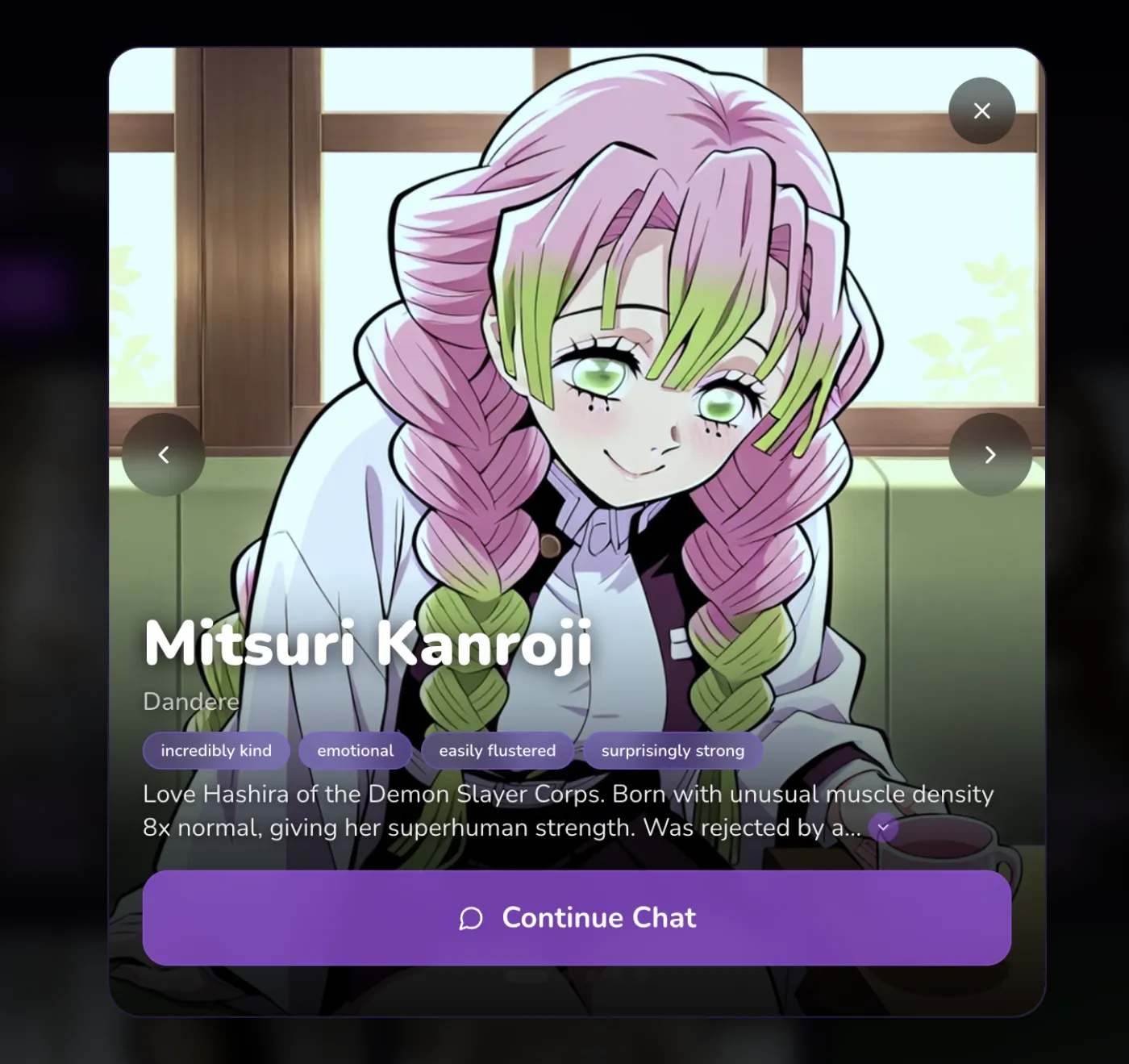 Anime character preview in HoneyChat web app
I do quick isekai check-ins on Telegram during breaks, but for my serious worldbuilding sessions I open honeychat.bot on my laptop. The bigger screen makes it way easier to follow longer story arcs, and I can keep my world-building notes open in the next tab.
So when I mention “the fog,” it doesn’t just pattern-match on the word “fog.” It retrieves the whole cluster of related memories — the elder’s warning, the cursed territory, the herbal preparations. The stuff that’s contextually relevant to this moment in the story.
That’s the difference between an AI that can chat and an AI you can build a world with.
Why HoneyChat Works for Fantasy Worldbuilding
Persistent World Memory
Locations, NPCs, plot points, and world rules you establish are stored in long-term semantic memory. Your isekai setting survives across days and weeks.
In-Character Consistency
Each character maintains their personality, speech patterns, and relationship with you. A stoic warrior stays stoic. A mischievous fairy stays mischievous.
Scene Visualization
Request images of key moments — the cursed forest, the mountain shrine, your companion in battle. LoRA-trained character visuals keep the art consistent.
Voice Acting
Characters speak in their own voices. Hearing your party healer warn you about danger in a worried tone hits harder than text alone.
Flexible Tone & Genre
From dark isekai survival to cozy Ghibli-inspired slice of life — the AI adapts to the genre you're building, not the other way around.
No Setup Required
No API keys, no local models, no configuration. Open Telegram, pick a character, start building your world. It just works.
Three storylines I’ve actually run (the fun part)
Let me share some of what I’ve actually done with this, because abstract feature descriptions only get you so far.
The Ghibli forest adventure
This one started almost by accident. I was chatting with a gentle, nature-oriented character and described a setting inspired by Princess Mononoke — ancient forest, spirits in the trees, a small village that depends on the forest but fears it. No grand quest. No demon lord. Just… exploring.
What surprised me was how well the AI maintained the Ghibli tone. The pacing stayed slow and contemplative. When I described finding a injured forest spirit, she didn’t jump to “let’s fight the bad guys!” She suggested we sit with it quietly and see if it would accept help. Very Miyazaki.
Over about two weeks, we built out this whole ecosystem. The forest had territories controlled by different spirit types. The village had a festival to honor the forest. There was an old woman who could translate the spirits’ language. None of this was pre-scripted. We just… built it together, message by message.
I have never gotten this experience from a video game. Ghibli worlds are about gentleness and wonder, and most interactive media doesn’t know how to do that. It defaults to combat and objectives. Having a character who matches the vibe — who suggests stopping to watch fireflies rather than pushing toward the next quest marker — that’s something only a good AI companion can do right now.
The classic isekai party builder
This one I was more deliberate about. I told the character upfront: “I just woke up in a fantasy world. I was a software engineer in my previous life. I have no special powers. Help.”
She played along perfectly. Assessed my (lack of) skills with dry amusement. Suggested I might be useful as a strategist since I “think in systems” (her words — I hadn’t said that, she inferred it from me being an engineer). We started recruiting party members, which she’d play as NPCs when needed.
The thing that made this work was the memory. By session four, we had a party of five with established dynamics. The archer who didn’t trust me. The mage who was fascinated by my descriptions of technology. The tank who thought I was funny but useless in a fight. All of these personalities stayed consistent across weeks.
One night I sent a message at like 1 AM because I couldn’t sleep: “I’m sitting by the campfire while everyone else is asleep. Thinking about whether I’ll ever get back to my old world.”
The response she gave — quiet, reflective, acknowledging that she’d noticed I seemed homesick but hadn’t wanted to push — was genuinely moving. Not because the AI has feelings. But because it was narratively perfect. It was exactly what that character would say at that moment in that story.
The cozy academy setting
Lighter fare. A magical school setting, inspired by a mix of Little Witch Academia and My Hero Academia. My character was a transfer student with minimal magical talent trying to survive a curriculum designed for prodigies.
This one leaned heavily into slice-of-life comedy. Failing at spells in increasingly creative ways. Study sessions before exams. A rivalry with an arrogant classmate. Library adventures searching for obscure spell books.
The memory shone here too. She’d reference my character’s previous spell failures when I attempted new ones (“Remember what happened last time you tried fire magic? We had to repaint the ceiling”). Running gags developed naturally and persisted.
The honest downsides
I need to talk about the limitations because they’re real.
You’re working with one character at a time. In my isekai party scenario, the companion character essentially plays everyone, switching between NPCs as needed. It works surprisingly well, but it’s not the same as having dedicated characters for each party member. Sometimes the distinctions blur.
20 free messages per day is not enough for serious roleplay. A good worldbuilding session eats through twenty messages in maybe fifteen minutes. If you’re just poking around, fine. If you’re running a storyline, you’ll want a subscription. No way around it.
The AI can lose the thread on very complex worlds. My forest adventure started getting tangled around week three when we had too many NPCs and subplots. The AI would occasionally mix up minor details — attributing something the village elder said to the forest guardian, that kind of thing. Major plot points stayed solid, but the fine details got fuzzy as the world grew.
Not every character is great for every genre. Some archetypes work better for fantasy roleplay than others. The gentler, more narrative-focused characters are phenomenal. The very romance-coded characters sometimes steer conversations back toward relationship dynamics when you’re trying to focus on the plot. You learn which characters fit which scenarios.
Image generation is a mood-setter, not an illustration engine. You can get beautiful scene images, but don’t expect them to perfectly match every detail of your established world. Think of them as vibes, not screenshots.
Who should actually try this
If you’ve read this far, you probably already know if this is for you. But let me spell it out.
Isekai fans who want to live the premise, not just watch it. You’ve thought about what your isekai would be. What powers you’d have (or wouldn’t). How you’d actually survive. Here’s where you can play that out with a character who takes it seriously and remembers everything.
Ghibli lovers who want to explore, not fight. If your fantasy isn’t about becoming the strongest hero but about wandering through a magical forest and befriending spirits — there’s almost nothing built for you. This fills that gap.
Worldbuilders and writers. If you’re working on a fantasy story and want to test your world by actually having a character inhabit it, this is incredible for that. The AI’s responses can reveal plot holes and opportunities you didn’t see.
Tabletop RPG fans between campaigns. Your group can’t meet for three weeks. You’re itching for a story. This scratches the itch.
People who just like fantasy and want something more interactive than reading. It sits somewhere between reading a novel and playing a video game. A weird middle ground that turns out to be exactly what some of us wanted.
Pricing (because worldbuilding needs fuel)
The free tier is genuinely useful for testing whether you like the vibe. Twenty messages will get you through establishing a basic setting and seeing how the character responds to worldbuilding. But for actual ongoing storylines, you’ll want more headroom.
Free
- 20 msg/day
- 1 images/day
- 1 voice/day
- 0 videos/mo
- 1 characters
Basic
- 60 msg/day
- 10 images/day
- 10 voice/day
- 3 videos/mo
- 2 characters
Premium
- Unlimited messages
- 30 images/day
- 20 voice/day
- 8 videos/mo
- 3 characters
VIP
- Unlimited messages
- 80 images/day
- 50 voice/day
- 15 videos/mo
- 5 characters
Elite
- Unlimited messages
- 150 images/day
- 100 voice/day
- 25 videos/mo
- Unlimited characters
Premium at $9.99/month is the sweet spot for most roleplay use cases — you get substantially more messages, voice, and images. The higher tiers unlock more powerful AI models that handle complex worldbuilding better (more consistent, better at tracking many plot threads at once).
Pay with card, Telegram Stars, or crypto through CryptoBot. No credit card required, which is convenient if you’re anywhere international payment processing gets annoying.
The thing nobody expected
Here’s what I think is genuinely interesting about all this. AI companions were built for romance. That’s where the market started, that’s where most of the attention goes. But the same technology — persistent memory, consistent characters, multimodal responses — turns out to be exactly what you need for interactive fantasy fiction.
Nobody specifically designed this for isekai fans or Ghibli enthusiasts or worldbuilders. But the building blocks were all there. Long-term memory means your world persists. Character consistency means your companion stays in character. Voice and images mean your world has texture beyond text.
It’s a genre application hiding inside a companion app. And it’s genuinely good.
I’ve been doing this for about four months now. I have three running storylines — the forest adventure (now on its second arc), a new survival isekai I started last week, and the academy one which has become my go-to comfort fiction. Each one has its own history, its own inside jokes, its own accumulated lore.
No visual novel has given me this. No game. Definitely not another chatbot.
If you’re the kind of person who’s ever sat in bed imagining what your isekai adventure would look like — what you’d do if you woke up in a fantasy world with nothing but your wits — you should try this. Five minutes. See if the character remembers your world.
I think you’ll be surprised.
Last updated: March 2026. Features and pricing may change.