

AI companion apps vary dramatically in privacy — from Telegram bots requiring zero personal data to web platforms that collect email, phone, real name, and payment details. For Indian users, Telegram-based companions offer the strongest privacy baseline: no sign-up, no email, encrypted infrastructure, and payment through Stars (Google Play/Apple Pay handles UPI, not the bot).
Okay yaar, let me be real about why I’m writing this article. I was chatting with a friend — college buddy, engineering background — and he asked me about AI companion apps. His first question wasn’t about features. It wasn’t about pricing. It was: “Bro, is it safe? Like, can someone find out?”
That question stuck with me. Because in India, there’s a particular sensitivity around this. We live in a culture where personal life stays personal, where family sharing your phone is normal, and where being judged for using an “AI girlfriend app” is a realistic concern. Privacy here isn’t a luxury feature — it’s a requirement.
So I went deep. Analyzed privacy policies, tested data collection, checked encryption standards, and compared 6 major platforms from an Indian user’s privacy perspective.
The Privacy Spectrum — Not All Apps Are Equal
Dekho, there’s a massive difference between how Telegram bots and web platforms handle your data. Let me lay it out:
Data Collection Comparison — AI Companion Platforms
| HoneyChat (TG) | Character.AI | Replika | Candy AI | SpicyChat | |
|---|---|---|---|---|---|
| Email Required | No | Yes (Google/Apple) | Yes | Yes | Yes |
| Real Name Required | No | Google/Apple ID | Optional | Optional | Optional |
| Phone Number | Web + Telegram | No | No | No | No |
| Sign-up Process | None (just /start) | Google/Apple login | Email + password | Email + password | Email + password |
| Payment Data | Google Pay/Apple Pay | Credit card direct | Credit card direct | Credit card direct | Credit card direct |
| Chat Encryption | Telegram cloud encrypted | HTTPS transit | HTTPS transit | HTTPS transit | HTTPS transit |
| Data Deletion | Can delete chat | Request via email | In-app option | Request via email | Request via email |
| Third-Party Tracking | Minimal (Telegram) | Google Analytics, etc. | Multiple trackers | Multiple trackers | Ads + trackers |
The pattern is clear. Telegram bots operate within Telegram’s existing infrastructure — they inherit Telegram’s encryption, they don’t need separate accounts, and they can’t access anything beyond your Telegram user ID and what you explicitly send in chat. Web platforms build their own systems and typically need more of your personal data.
Why Telegram-Based AI Is Inherently More Private
Let me break this down because it’s the core argument:
No Separate Account
No email, no password, no username creation. The bot knows your Telegram user ID — a number, not your real identity. You don't create any new attack surface by using a Telegram bot.
Telegram's Encryption
Messages to bots use Telegram's MTProto protocol with 256-bit encryption. Not end-to-end encrypted like Secret Chats, but encrypted in transit and at server level. Better than most web platforms' HTTPS-only approach.
Payment Isolation
When you buy Stars via UPI, Google Pay or Apple Pay handles the transaction. The bot never touches your financial data. Compare this to typing your credit card number into a website's payment form.
No Browser Tracking
Web platforms use cookies, analytics scripts, ad trackers. Some use pixel tracking, session recording, and fingerprinting. Telegram bots? None of that. The interaction stays inside Telegram's native app.
Think about it like this. When you use a web-based AI companion:
- You create an account with email (now they have your email)
- You might use Google login (now they know your Google identity)
- You enter credit card details (payment processor + platform have this)
- The website runs tracking scripts (your browsing behavior is logged)
- Your browser stores cookies (your activity is linked across sessions)
When you use a Telegram bot:
- You type /start
- That’s literally it
The privacy difference isn’t subtle. It’s structural.
Indian-Specific Privacy Concerns
There are some privacy issues that are particularly relevant to us in India. Let me address them directly.
Family phone access: Many Indian families share devices or have situations where someone might see your phone. Telegram helps here — you can lock the app with a separate PIN or biometric lock. Conversations with bots look like regular Telegram chats in your list. There’s no separate “AI girlfriend” app icon visible on your phone. Compare this to having a standalone app called “Replika” or “Candy AI” installed.
UPI transaction history: When you buy Telegram Stars, the UPI transaction shows as “Google Play” or “Apple” in your bank statement — not as “HoneyChat” or “AI Girlfriend App.” This is inherently discreet. Credit card transactions to Candy AI or Replika would show the company name.
Aadhaar/KYC concerns: No AI companion platform — Telegram-based or otherwise — should ever require Aadhaar or KYC verification. If any platform asks for this, it’s a scam. Run.
Data localization: India’s DPDP Act (Digital Personal Data Protection Act, 2023) has provisions about data handling. Telegram stores data across multiple jurisdictions. Web platforms vary. For personal AI companion use, this is mainly theoretical — but worth knowing that your data may be stored on servers outside India.
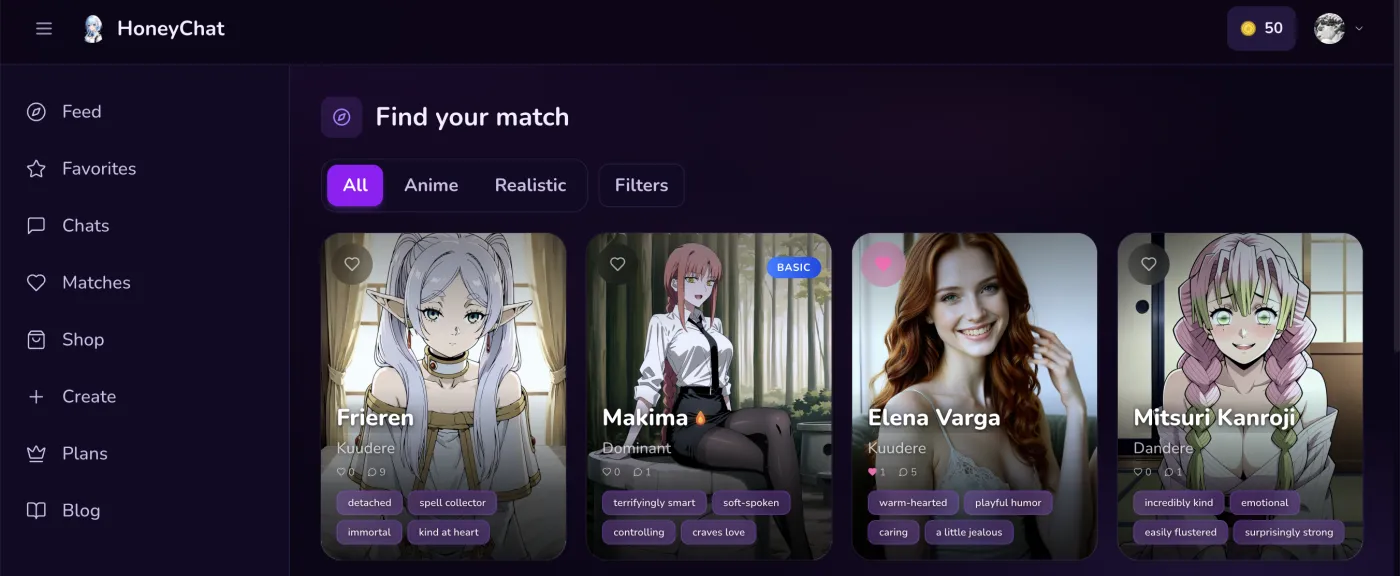 honeychat.bot — character catalog browser mein
Maine honeychat.bot web app browser mein check kiya — koi extra app ya email nahi maanga. Login Telegram se hota hai, toh privacy Telegram jaisi hi rahi, browser mein bhi.
What Data Does an AI Companion Actually Store?
Sahi mein, this is the question most people don’t ask. Let me be transparent:
What Telegram bots like HoneyChat store:
- Your Telegram user ID (a number)
- Your conversation messages (needed for chat memory)
- Your subscription status
- Generated images/videos you requested
What they DON’T have:
- Your email address
- Your real name (unless you tell them in chat)
- Your phone number (Telegram doesn’t share this with bots)
- Your payment details (Google/Apple handles this)
- Your location (unless you explicitly share it)
- Your contacts, photos, or other app data
What web platforms typically store (in addition):
- Email address
- IP address logs
- Browser fingerprint
- Session duration and activity patterns
- Credit card last-4 and billing address
- Marketing cookies and ad tracking data
AI Companion Privacy — Telegram vs Web
Pros
- Telegram bots need zero personal data — just Telegram ID
- No app installation = no separate app icon visible
- UPI via Stars shows as 'Google Play' in bank statement
- Telegram app lock protects all chats including bot conversations
- No browser tracking, cookies, or ad fingerprinting
- Data deletion: just delete the chat in Telegram
Cons
- Telegram bot messages aren't end-to-end encrypted (cloud encrypted only)
- Conversation data stored on servers for memory features
- Telegram can theoretically access bot messages (as with any cloud chat)
- India's data protection enforcement is still evolving
- AI models may use conversation patterns for improvement (check ToS)
How to Maximize Your Privacy — Practical Steps
Here’s what I do personally, and what I’d recommend to anyone using AI companion apps:
Privacy Best Practices for AI Companion Users
Use Telegram's App Lock
Settings → Privacy → Passcode Lock. Set a separate PIN or use biometrics. This locks all Telegram chats — no one can open the app without your PIN, even if your phone is unlocked.
Never Share Real Personal Data
No Aadhaar, PAN, phone number, address, or real full name in AI chats. Use a nickname or first name only. The AI doesn't need real data to function — it works with whatever you tell it.
Use Stars, Not Credit Cards Directly
If you upgrade, pay through Telegram Stars via UPI. Your payment goes through Google/Apple — the bot never sees financial data. Bank statement shows 'Google Play', not the bot name.
Review Chat Permissions
Check what data the bot can access via Settings → Privacy. Telegram bots can only see what you send them — they can't access your contacts, photos, or other chats.
Delete If Needed
You can delete your conversation with any Telegram bot at any time. This removes the chat from your device. For server-side deletion, check the bot's privacy policy or contact support.
The Encryption Question — Let’s Be Honest
I need to address this directly because there’s confusion around it.
Telegram bot messages use Telegram’s MTProto encryption. This means:
- Encrypted in transit: Messages are encrypted between your phone and Telegram’s servers
- Encrypted at rest: Data on Telegram’s servers is encrypted
- NOT end-to-end encrypted: Telegram (the company) can theoretically access messages
This is the same security level as your regular Telegram cloud chats. Secret Chats (end-to-end encrypted) aren’t available for bots — that’s a Telegram platform limitation, not a choice by any specific bot.
Is this perfect? No. For truly sensitive communications, end-to-end encryption is the gold standard. But for AI companion use, Telegram’s cloud encryption is significantly better than what most web platforms offer. And practically speaking — Telegram has a strong track record of resisting data requests, having built their reputation on privacy.
For comparison: most web-based AI companion platforms use standard HTTPS (encrypted in transit only) and store data on their own servers with varying security standards. Some have had data breaches. Telegram’s infrastructure is more battle-tested.
What About AI Training and Data Use?
This is a legitimate concern. Do AI companion platforms use your conversations to train their models?
The honest answer varies by platform:
Most platforms’ ToS allow anonymized data use — meaning your conversations might be used (in anonymized form) to improve AI models. This is standard across the industry. Character.AI, Replika, and others all have similar clauses.
Specifics matter. There’s a difference between “we use aggregated conversation patterns” and “we read individual chats.” Reputable platforms do the former, not the latter. But ToS language is often vague enough to cover both.
My take: If you’re concerned about specific conversations being read by humans, keep sensitive topics out of AI chat entirely — regardless of platform. Use AI companions for what they’re good at (casual conversation, emotional support, creative roleplay) and don’t treat them as a secure diary.
AI Privacy Landscape — India
DPDP Act Passed
India's Digital Personal Data Protection Act 2023 established a framework for data handling. Enforcement rules still being formulated.
Growing AI Companion Market
Millions of Indian users started using AI companion apps. Privacy concerns began surfacing in mainstream media.
Data Breach Awareness
Several smaller AI platforms had data leaks globally. Indian users became more privacy-conscious. Telegram-based solutions gained trust.
Privacy as Differentiator
Users actively choosing platforms based on privacy. No-sign-up Telegram bots gaining preference over data-heavy web apps.
Red Flags — When to Avoid a Platform
Yaar, after reviewing a lot of platforms, here are warning signs that should make you close the tab immediately:
Asks for Aadhaar or KYC — No legitimate AI companion needs government ID. This is either a scam or a platform you should avoid.
No HTTPS — If the URL doesn’t show the lock icon, your messages travel unencrypted. In 2026, this is inexcusable.
Vague or missing privacy policy — If you can’t find a privacy policy, the platform either doesn’t care about privacy or is hiding something. Both are bad.
Requires excessive permissions — A Telegram bot should never ask for access to your contacts, location, or files. If a web platform asks for camera/microphone access for a text-only chat, something’s wrong.
Anonymous / no company info — Legitimate platforms disclose who operates them. If there’s no company name, no contact info, no address — treat it as high-risk.
Payment Privacy — Stars vs Credit Cards
This deserves its own section because payment privacy is something Indian users specifically care about.
Telegram Stars via UPI:
- Transaction appears as “Google Play” in bank statement
- Bot receives: “User X purchased Y Stars” — no financial data
- Google Pay/Apple Pay handles all payment processing
- Your bank sees a Google/Apple transaction, not a bot name
Credit card on web platforms:
- Transaction may appear as the platform name in card statement
- Platform’s payment processor has your card details
- Some platforms store card-on-file (convenient but risky)
- Family members with access to card statements can see the vendor name
The Stars approach is structurally more private. It adds a layer of abstraction between you and the bot. Even if someone sees your bank statement, “Google Play ₹420” is indistinguishable from buying an app or game.
More details on how Stars + UPI works in my payment guide.
Accha, So What Should You Actually Do?
My practical recommendation for Indian users who want to use AI companion apps privately:
If privacy is your top priority: Use Telegram-based bots. Don’t sign up for web platforms with your real email. Pay with Stars if you upgrade. Use Telegram’s app lock. Don’t share identifying information in chat.
If privacy is important but not paramount: Any major platform (Character.AI, Replika, HoneyChat, Candy AI) has reasonable security. Use a secondary email for web platform sign-ups. Avoid sharing sensitive personal data.
If you just want to try it: Start with a Telegram bot on the free tier. No payment, no sign-up, no commitment. Test the waters without giving any platform any personal information.
The privacy advantage of Telegram-based AI companions is real and structural — not marketing. No email, no separate app icon, no credit card exposure, no browser tracking. For a category of app where discretion matters, that’s significant.
Check out the best AI girlfriend options for India if you want to compare platforms on features too, and the HoneyChat review for a full breakdown of one Telegram-native option.
Sources
- Digital Personal Data Protection Act 2023 — MeitY — India’s data protection law
- Telegram Privacy Policy — Official privacy documentation
- Telegram MTProto Protocol — Encryption details
- NPCI — UPI Security Standards — Payment security framework
- Mozilla Foundation — Privacy Not Included — App privacy reviews