
The gatekeeper will open the bridge if you surrender the parcel. The ferryman will take you across, but wants to know who sent it. You could also walk away. That small decision is enough to begin an adventure: a place, something you want, and a cost you can understand.
HoneyChat’s worlds give that decision somewhere to happen. You play your own character while the AI narrates the surroundings and other people. You can start in the browser, use a ready-made setting, and discover whether you enjoy the conversation before committing to a long campaign.
Worlds to explore




Pick a world with a problem you want to solve
A beautiful setting is useful, but a reachable objective makes the first session easier. Deliver a letter, find someone before the last ferry, or decide whom to trust at a closed city gate. Save the ancient prophecy for later. You need a reason to take the next turn more than you need a complete history of the kingdom.
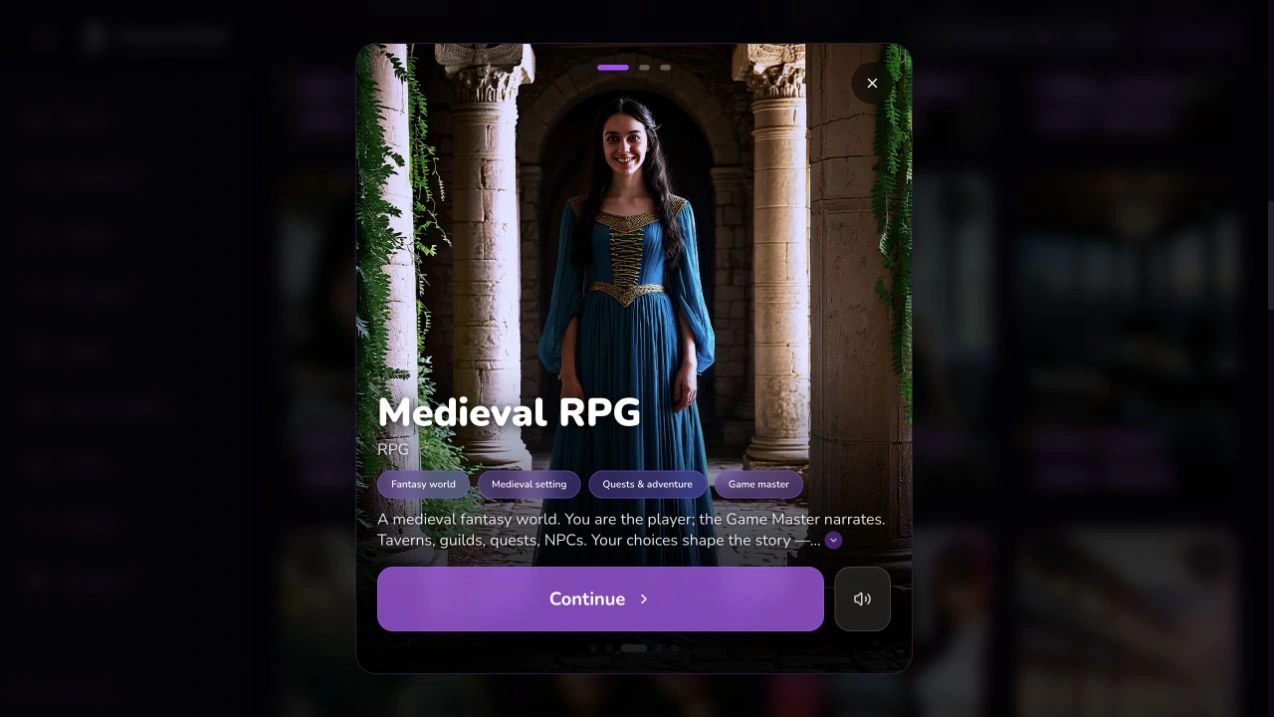
Open a world card and read its premise. A world is a different starting point from a single companion: the narrator can bring locations, quests, and a cast into the same adventure. A group card is useful when you mainly want conversations among an established cast. The full HoneyChat guide explains those formats alongside the rest of the app.
Choose the kind of session you want
Explore a world
Follow a place, a goal, and the people you meet along the way.
Speak for your hero
Describe your own actions and dialogue. Leave other people's responses to the narrator.
Keep a question open
A missing delivery or a strange signal gives your next action a purpose.
For a first visit, a ready-made world is less work than inventing everything at once. Medieval RPG is a straightforward fantasy starting point. If the genre itself is what attracts you, the separate isekai roleplay guide explores that particular kind of journey. Here, the useful question is simply what you want to do in your next scene.
Start with an action, rather than an entire ending
You do not need special command syntax. Write what your character attempts, why, and the limit you want the narrator to respect. “I try to persuade the guard” leaves room for a response. “The guard agrees, gives me the key, and declares me ruler” has already consumed the interesting part of the turn.
Use the opening below as a starting point and adapt it to your chosen world’s premise. Keep the setting consistent with the card you chose.
I am an adult courier arriving at a river town after the bridge has closed. I need to deliver a sealed parcel to the lighthouse keeper. I have no special powers. Introduce one obstacle and someone with a reason to help. Keep the scene grounded in this world, and stop before choosing my next action.
That gives the narrator something concrete to work with. Your character has a role, an immediate task, and a limitation. You can then ask a question, inspect a place, or make an offer. If the response introduces too many people, request a smaller scene before continuing.
Your first playable scene
Read the premise
Choose a world whose starting situation already interests you.
Choose an opening
Use an available opening and check the model, reply style, and difficulty shown at the start.
Make a limited attempt
Say what your hero tries, without writing the result for the narrator.
Notice the consequence
Respond to what actually changed before introducing a different task.
What the adventure can carry between turns
There is more to a campaign than the last chat bubble. HoneyChat already has world state, NPC reputation, memory facts, a story journal, and a scene directive. They serve different jobs. Keeping those jobs separate makes a longer story much easier to steer.
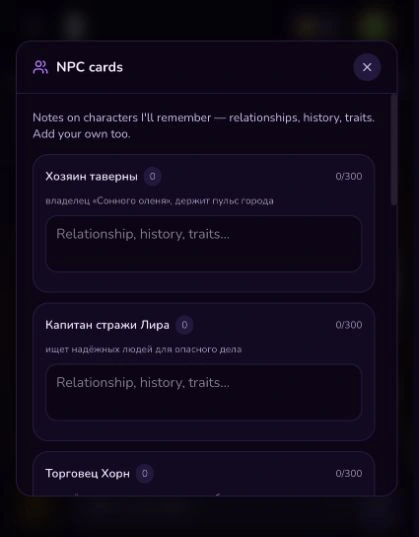
NPC reputation records the relationship with individual people in a world. It is a story signal, not a universal morality score or a guarantee that a particular line will produce a fixed reward. A suspicious guard and a grateful innkeeper can react differently to the same hero. The narrator still needs to interpret the situation coherently.
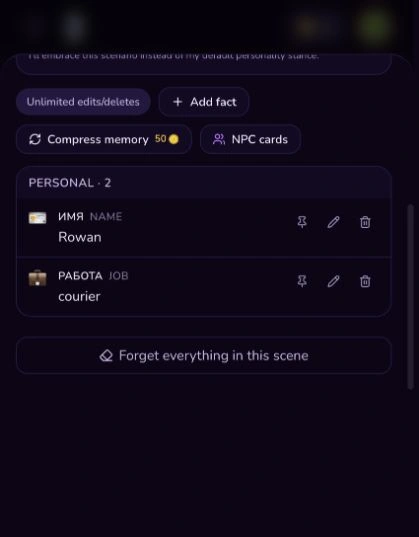
Memory facts hold selected details from the conversation. Check a fact if the AI repeatedly gets an identity or agreement wrong; do not reinforce the error by accepting it in every new reply. Fact editing has plan limits, and manually adding facts is available from Elite. The memory and continuity discussion also helps distinguish continuing a story from generating a fresh passage.
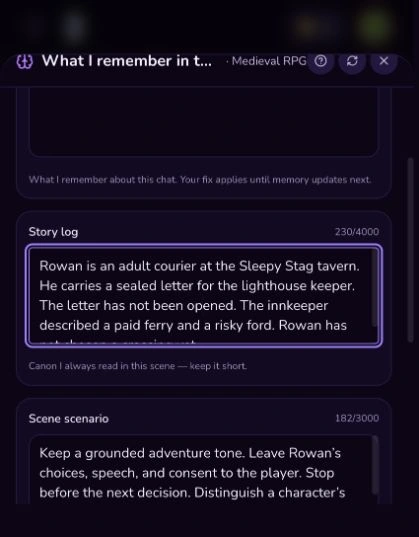
The story journal, available from Premium, is the place for durable canon: who holds the parcel, which bridge is closed, and what you have already agreed. The scene directive, available from VIP, guides how the current scene should be played. It can ask for a restrained narrator, protect your control of the protagonist, or focus the scene on a negotiation. Neither is a promise that the model will never make a mistake.
Put each note in the right place
| What belongs there | Example for the courier | |
|---|---|---|
| Story journal | Established canon | The parcel is sealed; the bridge is closed. |
| Scene directive | How this scene should unfold | Keep the negotiation tense; do not choose my answer. |
| Memory fact | A specific remembered detail | My character is a courier, not the lighthouse keeper. |
| NPC reputation | An individual relationship | The ferryman has reason to distrust me. |
A journal that helps instead of becoming another novel
Write changes, rather than copying every paragraph. A short journal can preserve the useful shape of an adventure without burying it under descriptions of weather, clothing, and repeated greetings. Separate something established from something merely suspected. “The ferryman stole the parcel” and “I suspect the ferryman” lead to very different stories.
An original compact entry could read:
Current place: the closed bridge at dusk. Goal: reach the lighthouse keeper. Confirmed: I still carry the sealed parcel; the gatekeeper has not opened the crossing. Relationship: the ferryman offered help in exchange for information. Unresolved: whether the sender is trustworthy. Next decision: ask about another crossing or bargain for passage.
Update that entry when an agreement, possession, or objective changes. Do not turn every passing remark into permanent canon. If you want a personal backup, keep your own copy of important notes as well. That is especially helpful before a major rewrite or when returning after a long break.
Fix a contradiction at the point where it appears
Suppose the next reply says you opened the parcel, although you deliberately left it sealed. Correct that specific point: “The parcel remains unopened. Continue from my attempt to negotiate at the gate.” There is no need to reconstruct the entire town or shout a longer version of the same instruction.
Next, check whether the incorrect detail has also entered a journal entry or memory fact. A corrected sentence in the conversation and an old contradictory note can pull the story in different directions. Put the same established version in the places you actively use.
If you want a completely different branch, mark it as a deliberate change. “Let’s restart from the bridge with a different offer” is clearer than quietly pretending a previous agreement never happened. A branch is a creative choice; an accidental contradiction is something to repair. The broader roleplay chatbot guide discusses choosing a format that suits the amount of direction you want to provide.
A useful repair has a small target
Name the established detail
The parcel is unopened. The guard has not agreed yet.
Check the relevant note
Keep the journal and facts aligned with the version you want to continue.
Give the next playable beat
Return to the unfinished question instead of retelling the entire chapter.
Set the pace and difficulty separately
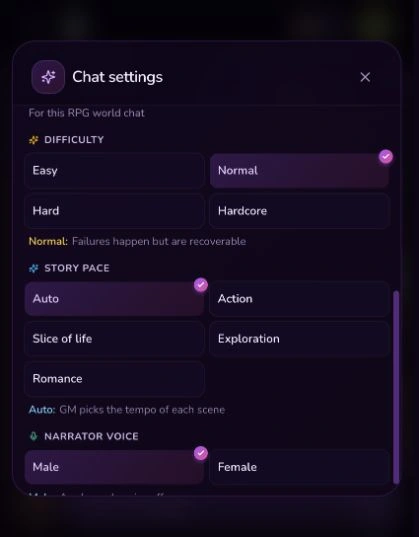
For a quiet adventure, ask for a short scene with a clear place to respond. For a cinematic one, allow more description, but still ask the narrator to stop before your next decision. Reply style, story pace, and difficulty address different parts of the experience. Faster narration should not have to mean a more punishing world.
World settings already include difficulty choices. Hard is available from Premium and Hardcore from VIP; check the options shown for the model and plan you use. The current experience relies on narrative instructions for difficulty. It should not be described as a fully deterministic tabletop rules engine.
What is being prepared for RPG and dice
HoneyChat is developing optional RPG inventory and d20 checks for world chats. The planned flow shows a check’s difficulty and modifier before the roll, then continues the story from the result. These features are not yet available, and a release date has not been announced. Reputation, facts, journal, and scene directive can already support an ongoing adventure.
Choose a starting point and a sensible stopping point
For a short session, finish after a decision has produced a visible change. You learned who controls the bridge, reached the lighthouse, or decided the delivery is too dangerous. A natural stopping point is more satisfying than ending halfway through a paragraph because you tried to fit an entire saga into the evening.
Before leaving, note your location, the unresolved task, and the last agreement. On return, read those notes before adding a new twist. You can ask the narrator to briefly establish the present scene without revealing future secrets or deciding what your hero does next.
HoneyChat’s Free plan includes 20 messages per day. Use that allowance to check the world and writing style; journal, directive, model, and media access depend on the plan. Photos, voice, and video have separate allowances, and a generated voice is synthetic rather than a live call. The pricing guide explains the wider subscription choices.
Access for story features
Free account
Twenty messages per day. Guest previews have separate limits.
Premium and above
Story journal; text and media allowances are separate.
VIP and above
Scene directive for the current narration.
Elite and above
Manually add memory facts; editing also follows plan limits.
HoneyChat works best here when you bring a small decision and let the world answer it. Choose a setting, make an attempt, and inspect the consequence before adding more complexity. Your first adventure can start with a closed bridge and a parcel you have not opened yet.
Further reading
AI Dungeon’s play guide describes another text-adventure interface. Its memory explanation discusses context limits. SillyTavern’s group-chat documentation describes a different way to organize multiple speakers. These are background references; their controls and features are not HoneyChat controls.