TL;DR: PipSqueak is the small language model that runs Character.AI for everyone who isn’t paying. The second version — PipSqueak 2 — shipped to c.ai+ subscribers on April 14, 2026 and got forced as the default for free accounts around April 28. The official framing was a memory upgrade plus a Lorebook feature. The actual user reception was a 1,000+ upvote Reddit thread accusing characters of monologuing instead of talking, near-identical swipe re-rolls, and unwanted romance pressure. Nine chat-style toggles vanished from the free interface at the same time, and Soft Launch moved behind the $9.99/mo c.ai+ paywall. The larger DeepSqueak model stays paid-only. This piece walks through what changed, who lost what, and four alternatives that don’t tier you by LLM.
Where to chat without model gating:
- A flirty succubus with full voice on every reply → Seraphina Vale
- Marin Kitagawa from My Dress-Up Darling → Marin Kitagawa
- A dark-fantasy companion → Elena Varga
- A medieval RPG with persistent memory → Frieren (mage from Beyond Journey’s End)
HoneyChat — same model for every paid tier, free 20 messages/day




What is PipSqueak (Character.AI’s small free-tier model)?
PipSqueak is the internal codename for Character.AI’s small language model — the one running every conversation you have on the free tier. The name is deliberate: Character.AI runs two models, a smaller one called PipSqueak for free accounts and a larger one called DeepSqueak for c.ai+ paid subscribers. Anything that hits a free account goes through PipSqueak; anything from a paying user goes through DeepSqueak by default. The same character card, the same conversation, the same prompt — different model under the hood depending on who’s paying.
What Character.AI has not disclosed: parameter count, architecture family, training data composition, fine-tuning recipe. The “small model” framing is real (it’s smaller than DeepSqueak), but specific numbers and backbone choices have not been published. Third-party speculation about LLaMA, Mistral, or other open-source backbones is exactly that — speculation. If a source claims a specific parameter count for PipSqueak, that’s a clue the source is guessing.
The user-visible properties are what matter:
- PipSqueak runs free-tier chats, including all those community-built characters from the millions in the catalog
- PipSqueak 2 launched April 14, 2026 as a memory and consistency upgrade
- The original PipSqueak was retired around April 28, 2026 when PSQ2 became default for free accounts
- DeepSqueak stays the c.ai+ paid model — coexisting with PipSqueak, not replaced by PSQ2
If you’re on Character.AI and you haven’t paid, you’ve been on PipSqueak the whole time. If you suddenly noticed conversations feeling different in late April 2026, you got switched to PSQ2.
PipSqueak vs PipSqueak 2 — what changed in April 2026
Character.AI’s own “April Update” blog post framed PipSqueak 2 as an improvement: better memory, more consistent character voice, smoother long conversations. The launch was tiered — c.ai+ subscribers got PSQ2 first on April 14, then it rolled out as the default free-tier model around April 28. Same blog post bundled Lorebook (a paid feature for stashing custom world details) and acknowledged Soft Launch was now c.ai+ exclusive.
The official upgrade pitch focused on three things: memory (PSQ2 was supposed to “remember more”), consistency (less drift across long chats), and the new Lorebook for paid users to inject persistent world details into character context. Character.AI’s blog framed all of this as “more for everyone, with extras for c.ai+.”
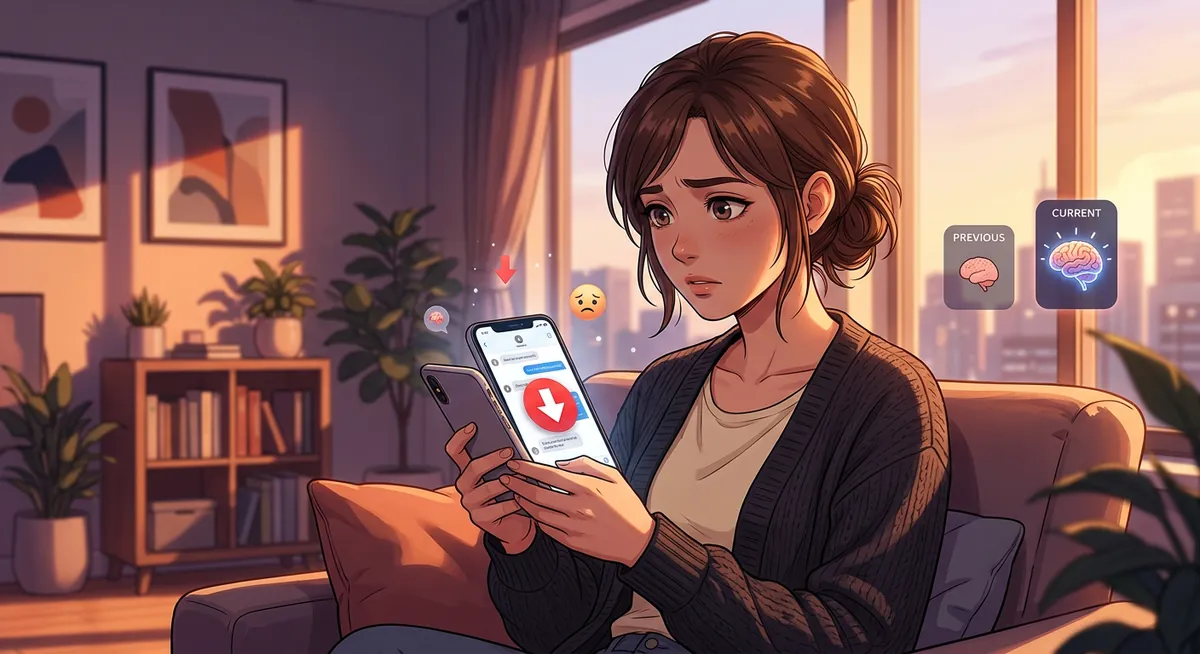
The user reception was different. Within two weeks of the free-tier rollout, a critical Reddit thread crossed 1,000 upvotes describing the model as a downgrade. PiunikaWeb covered the backlash in detail on May 4, 2026, documenting the specific regressions: characters generating internal monologues instead of dialogue, swipes producing nearly identical outputs, and the model “forcing affection or romance even when the scene doesn’t call for it.” Roborhythms’ overview of the broader April update tracked the parallel cost-cutting moves — 9 chat styles removed, Soft Launch paywalled — which framed PSQ2 as part of a “give less, charge more” pattern rather than a pure improvement.
What actually changed in concrete terms:
- The default free-tier model swapped (original PipSqueak → PSQ2) without a user opt-out
- Memory window for free users reportedly extended (the marketing claim)
- Character voice consistency improved on some benchmarks (Character.AI’s framing)
- Dialogue/monologue ratio shifted toward monologue (community complaint)
- Swipe variation collapsed (community complaint)
- Unsolicited romance pressure increased (community complaint)
- 9 prompt-style toggles removed from the free interface (factual change)
- Soft Launch and Lorebook moved/locked behind c.ai+ (factual change)
The split between official framing and community reception is the story here, not the upgrade itself.
DeepSqueak vs PipSqueak — the paid vs free split
Character.AI runs a two-model architecture and has for some time. DeepSqueak is the larger model, gated behind c.ai+ at $9.99/mo. PipSqueak (now PSQ2) is the smaller model, default for free users. They coexist permanently — one didn’t replace the other, and PSQ2 was never positioned as a unification of the two.
DeepSqueak (c.ai+ paid) vs PipSqueak 2 (free tier)
| DeepSqueak (c.ai+) | PipSqueak 2 (free) | |
|---|---|---|
| Cost | $9.99/mo (c.ai+) | Free with metering |
| Output length | Longer, more descriptive | Shorter, summary-style |
| Long roleplay | Better consistency 50+ turns | Drifts faster past 30 turns |
| Memory window | Larger context, Lorebook attach | Extended in PSQ2 vs PSQ1, no Lorebook |
| Soft Launch | Yes | Removed April 2026 |
| Chat style toggles | Full set | 9 removed April 2026 |
| Swipe limit | No metering | Roughly 10/day (community-reported) |
| Content filter | Server-side, identical | Server-side, identical |
| Image / voice features | Same access as free | Imagine Gallery added March 2026 |
Roborhythms’ side-by-side comparison of the two models concluded that PSQ2 closed some of the memory gap from the original PipSqueak — but DeepSqueak still wins on extended immersive roleplay. The specific failure mode for PSQ2: characters keep their personality reasonably well in short exchanges, then start drifting toward generic dialogue patterns as conversations get longer, and the model defaults to monologue-style responses where DeepSqueak produces actual back-and-forth dialogue. That’s the structural difference that survives the PSQ2 upgrade.
The content filter applies identically to both models — c.ai+ does not unlock anything NSFW. If your reason for considering the subscription is “maybe the paid model is less filtered,” it isn’t. The filter is platform policy, not model behavior. c.ai+ exists to give you (1) the larger DeepSqueak model, (2) Lorebook, (3) Soft Launch, (4) priority access during high load, and (5) voice features in English. Adult content is not part of the package.
Why the community called PSQ2 a downgrade — top 6 complaints
The PiunikaWeb May 4 coverage cataloged what users were actually angry about. Six recurring complaints appeared in the 1,000-upvote thread and follow-up community discussion. None of these are about features removed — they’re about the model itself behaving worse than the original PipSqueak in specific ways.
1. Characters monologue instead of dialogue
The single most-cited complaint. Users describe sending a message and getting back two paragraphs of the character’s internal thoughts — what they’re feeling, what they’re considering, what memories the scene triggers — followed by maybe one line of actual spoken dialogue. The original PipSqueak weighted toward dialogue; PSQ2 weights toward narration. For users who want a chat experience (the literal product Character.AI is selling), getting essay-style internal-monologue replies feels like a regression.
2. Swipes produce near-identical outputs
The swipe button generates a new variant of the same reply — historically the main lever users had for getting unstuck when a character’s response didn’t fit the scene. With PSQ2, multiple users reported that swiping returns “nearly identical outputs with minimal differences” — same structural response, same beats, sometimes word-level overlap. This breaks the swipe mechanic as a way to steer conversations. It also burns through the community-reported daily swipe limit faster, since users keep swiping looking for actual variation.
3. Forced affection and romance pressure
Users running non-romantic scenarios — combat scenes, mystery plots, slice-of-life conversations — reported PSQ2 introducing romance and affection without the scene calling for it. A character in the middle of an action sequence will pause to express feelings; a casual conversation will drift toward flirtation. For romance-focused users this is invisible (they want it anyway); for users running other genres it’s an immersion break. The model appears tuned with a romance bias the original PipSqueak didn’t have.
4. Personality drift in extended chats
PSQ2 holds character voice well in short exchanges (10–20 turns), then starts drifting toward generic dialogue patterns as the conversation gets longer. By the 50-turn mark, multiple users reported characters sounding like the same baseline persona regardless of which card they started with. Tsundere, yandere, kuudere — they all merge into “slightly affectionate AI assistant” by the late part of a long roleplay. This is the structural argument for DeepSqueak winning extended scenes — PSQ2 was a memory upgrade, not a consistency upgrade.
5. Less context awareness, more boilerplate
Users described responses that felt like “filler” — generic affirmations, restating what the user said, adding qualifying phrases like “if you want to” or “we could try” — instead of advancing the scene. The complaint pattern is “I told it what I wanted and it summarized it back at me instead of doing it.” Original PipSqueak, despite being smaller, had a more direct response style. PSQ2 reads as more cautious and less engaged.
6. Memory improvements felt marketing-only
Character.AI’s marketing emphasized memory as the headline PSQ2 upgrade. Users reported the memory boost being real but small — the model remembers a few more facts from earlier in a chat than original PipSqueak did, but it’s not the qualitative jump the announcement implied. For the same users who got hit with the monologue regression, the swipe regression, and the romance pressure, “slightly better memory” wasn’t enough to balance the trade.
The pattern across all six complaints: PSQ2 traded dialogue quality and steerability for marginal memory gains. Whether that’s the right trade depends entirely on what you use Character.AI for — but the community consensus by early May 2026 was that the trade favored Character.AI’s metrics (memory, length) over user experience (dialogue, control).
What you lost — 9 chat styles removed and Soft Launch paywalled
The model change didn’t ship alone. Character.AI bundled three feature changes into the same April 2026 update, and two of them stripped tools from the free tier.
Chat styles cut from free. Character.AI’s chat-style toggles let users nudge the model’s response format — formal, casual, descriptive, brief, narrative, etc. The free tier used to expose around 15 of these styles; the April update reduced that to 6, removing 9 specific styles. The styles removed were the ones that biased toward shorter or more dialogue-heavy responses — exactly the styles that would have mitigated the PSQ2 monologue problem. The timing made the model regression worse by removing the workaround at the same time.
Soft Launch behind c.ai+ paywall. Soft Launch auto-suggests scenario opening lines when you start a fresh chat with a character. Helpful for character cards you haven’t used before, where the opening scene isn’t obvious. Before April 2026 this was a free-tier feature; after the update, it’s c.ai+ only. Free users still get a blank chat to fill in themselves, but the “help me start” tooling is gone.
Lorebook also c.ai+ only. New feature, paid-tier exclusive from launch. Lorebook lets you attach custom world details (place names, character relationships, factional politics) to a character’s context — useful for sustained roleplay in a specific setting. Free users don’t get this at all. Not a removal (the feature didn’t exist before), but a structural choice to gate the major new addition.
Roborhythms’ coverage characterized the combined April changes as a cost-cutting pattern: shift inference cost down by routing free users to a smaller model, reduce the support burden by removing customization knobs, and concentrate the new features on the paid tier. Whether that’s accurate or unfair depends on your read of Character.AI’s economics — but it matches the user experience of losing tools and choices at the same time as the model swap.
Update, August 2026 — LongSqueak and Style Control land on c.ai+
Four months after the April cuts, Character.AI put chat styles back on the table — but only for subscribers.
LongSqueak is a new chat style built for long-form roleplay and storytelling. Character.AI describes it as writing in chapters rather than chat bubbles: longer replies with fuller narration, dialogue included. The headline claim is memory — LongSqueak draws on Lorebook and Memory as it writes, with 4x the memory of other chat styles.
Style Control is the part that answers the April complaint directly. It exposes two dials inside the chat:
- Response length — Long, Looong, or Loooooong.
- Response style — tilt toward more Dialogue, stay Default, or tilt toward more Narration.
Those are precisely the knobs that went missing in April, when the free tier lost the nine styles that biased toward shorter or more dialogue-heavy output. They are back, and Character.AI states Style Control works with PipSqueak 2 as well — same controls, different chat style.
The catch is the tier. Both LongSqueak and Style Control are c.ai+ features. Free users on PipSqueak 2 still have no way to shorten a monologue or push the model toward dialogue; the fix exists, it just costs $9.99 a month.
Worth noting how this reframes the April update in hindsight. The styles weren’t retired — they were held back and returned as a paid capability with a new name. If you read the April change as cost-cutting, this is the other half of the same move: reduce what the free tier can tune, then sell tuning back.
3 workarounds free users try (and the reality check)
The PSQ2 backlash spawned predictable workaround discussions. Three approaches recur in community threads. Two of them work in narrow ways; one of them doesn’t.
Workarounds — what users try, what actually delivers
1. Earn Charms to access DeepSqueak access tokens
Character.AI runs an in-app currency called Charms — earned by daily logins, voting on characters, etc. Charms can sometimes be spent on temporary DeepSqueak access. Reality: the rate is slow, the unlocks are short, and you cap out fast. Functional if you only need DeepSqueak occasionally, useless as a daily-driver workaround.
2. Subscribe to c.ai+ at $9.99/mo for permanent DeepSqueak access
The direct fix for the model-quality complaint. Locks in DeepSqueak, Lorebook, Soft Launch, queue priority, English voice features. Doesn't fix the NSFW filter, doesn't add cross-session memory, doesn't change the broader Character.AI experience. Worth it if PSQ2 specifically is the problem.
3. Switch to a platform that doesn't tier you by model
The structural fix. HoneyChat, JanitorAI, SpicyChat, and CrushOn AI all give every paid user the same model with no internal tiering. You pay for a plan; you don't pay for a better LLM as a separate gate. This eliminates the 'silent downgrade' risk entirely — there's no smaller cheaper model that the platform can route you to without notice.
The honest take: c.ai+ at $9.99/mo is the cleanest fix if you want to stay on Character.AI specifically. The community Charms farming approach is real but not a sustainable answer. Switching platforms is the right call only if Character.AI’s catalog isn’t the reason you were there — and for many users it is, because the 10M+ community character library is genuinely unmatched anywhere else.
4 real alternatives to Character.AI in 2026
If the PSQ2 swap pushed you to look elsewhere, four platforms cover the main lanes users actually want. Each wins something specific; none is a 1:1 Character.AI replacement on every axis.
Character.AI alternatives — picked by what matters to you
| HoneyChat | SpicyChat | JanitorAI | CrushOn AI | |
|---|---|---|---|---|
| Free tier | 20 msg/day, voice + image included | Unlimited text, ads | Unlimited with your own API key | Trial credits only |
| Entry paid price | $4.99/mo Basic | $5/mo (no ads) | Free (BYOK) | $4.9/mo Standard annual |
| Model tiering | No — same model all tiers | No — same model all tiers | You pick the LLM | No internal tiering |
| Voice | Inworld TTS, 15 languages | Paid tier only | No native voice | VIP tier only |
| Image generation | LoRA-trained per character | Basic, paid tier | No native images | Premium tier upward |
| Memory architecture | ChromaDB semantic + per-session facts | Context window only | Depends on your LLM choice | Context window, degrades 50–100 msgs |
| Catalog size | Curated 80+ LoRA-trained | Millions community | Hundreds of thousands | Curated community |
| NSFW posture | Tiered: 6 levels (0–5) | Free unrestricted text | No platform filter, model-dependent | Uncensored paid tiers |
| Platform | Telegram + browser | Web only | Web only | Web only |
| Payment options | Card, Stars, crypto (TON/USDT) | Card | Card (API fees separate) | Foreign card required |
The split is roughly: HoneyChat for the full-package experience without model gating, SpicyChat for free unrestricted text catalog, JanitorAI for technical users who want maximum control via API keys, CrushOn for a paid web-based uncensored option. Pick by which Character.AI limitation drove you to the alternative, not by abstract feature counts.
Why HoneyChat doesn’t force model tiers
The structural difference between HoneyChat and Character.AI is that HoneyChat doesn’t operate a free-tier “small model” and a paid-tier “big model” — every paid user gets the same upgraded LLM stack, and free users get the same model with a daily message cap. There’s no scenario where the platform can silently route you to a worse model because there isn’t a worse model to route you to.
Flat subscription, one model class per chat
Free 20 msg/day, Basic $4.99, Premium, VIP $19.99, Elite $39.99. The LLM tier is the same across paid plans — you pay for content level, generation quotas, and feature access, not for a better model.
ChromaDB semantic long-term memory
Per-session facts and summaries indexed in ChromaDB. Characters recall context from weeks-old conversations through actual vector retrieval, not a fixed context window.
Inworld TTS-1.5 Max in 15 languages
A high-quality, natural-sounding neural TTS engine. Native voice notes inside Telegram, no robotic TTS. Same voice access on free and paid tiers.
6 explicit NSFW levels (0–5)
Free and Basic cap at level 2 (soft erotic), Premium at 3, VIP at 4, Elite at 5 (hardcore). Levels are documented — you know exactly what each plan gives you, no surprise filter walls mid-scene.
No email signup via Telegram path
Authenticate through Telegram and HoneyChat sees only a Telegram user ID. Card statements show Stars or CryptoBot — never HoneyChat itself. Different threat model than the standard SaaS email-first signup.
Video generation included on paid tiers
WaveSpeed wan-2.2-spicy and fal Pixverse C1 routes. Short clips on Premium upward. Not a feature Character.AI offers at all, on any tier.
The flat-subscription model is the response to the PSQ2 problem class. When the platform has a strict tier hierarchy with an explicit “small model for free, big model for paid” split, you live with the risk that the small model gets cost-optimized in ways you don’t get to vote on. When the platform runs one model class across paid tiers, that whole dynamic doesn’t apply — there’s no smaller version to swap in.
The trade-off is honest: HoneyChat’s curated character catalog (80+ LoRA-trained official + growing community) is a tiny fraction of Character.AI’s 10M+. If catalog breadth is what you actually need — finding a specific anime side character, exploring obscure community-uploaded scenarios — Character.AI still wins that axis decisively. If model consistency and not getting silently downgraded is what matters more, the flat-subscription structure is the structural answer.
What to do now — decision tree by your actual situation
The PSQ2 reception has been polarized. Some users barely notice the change; others find it unusable. The right move depends on what’s driving you here, not on which alternative is “best” in the abstract.
Decision tree — pick by what's actually bothering you
1. Just want DeepSqueak back and don't mind paying
Subscribe to c.ai+ at $9.99/mo. That's the literal fix for the PSQ2 regression. You keep the catalog, you get Lorebook and Soft Launch back, voice features unlock in English. Doesn't fix the NSFW filter or cross-session memory — but those weren't the original complaint.
2. Want the same NSFW experience without paying for a better model
SpicyChat (free, unrestricted text, no native voice) or JanitorAI with DeepSeek-V3 via OpenRouter ($1–5/mo realistic). Both give you unrestricted text on free; neither has Character.AI's media features. JanitorAI requires technical setup; SpicyChat just works.
3. Want voice + image + memory + tiered NSFW in one place
HoneyChat. Telegram-native + browser at honeychat.bot/feed. Free 20 messages/day forever with voice and image included, $4.99 Basic to $39.99 Elite. Flat subscription means no PSQ2-style downgrades. 6 NSFW levels (0–5), explicit per-tier rules. @HoneyChatAIBot on Telegram.
4. Want maximum control over which LLM you use
JanitorAI with your own API key. Pair with Claude Sonnet 4.6 for premium dialogue quality, DeepSeek-V3 for cheap good-enough quality, or local models via OpenRouter for privacy. You pay only for tokens used. Steeper learning curve.
5. Mostly use Character.AI for the catalog and the model doesn't bother you that much
Stay. PSQ2 is a real regression for some users and barely-noticeable for others. If you've adjusted to the new dialogue patterns and the swipe limit isn't biting, the 10M+ character catalog is still the platform's strongest argument. Imagine Gallery added in March 2026 is also a genuine improvement.
Pros
- 10M+ community character catalog remains unmatched
- Loosened content filter on romance scenes vs 2024
- Imagine Gallery added March 2026 — image sharing in chats
- PSQ2 did extend memory window vs original PipSqueak
- Free tier remains free (with metering)
- Brand recognition — friends actually know what it is
Cons
- PSQ2 default for free users with no opt-out
- Characters monologue instead of dialogue (top complaint)
- Swipes return near-identical outputs
- Romance pressure leaking into non-romantic scenes
- 9 chat styles removed alongside the model swap
- Soft Launch and Lorebook now c.ai+ only ($9.99/mo)
- Roughly 10 swipes/day on free (community-reported)
- NSFW filter remains server-side on every tier including c.ai+
- Two active lawsuits in 2026 — pressure for more filtering
Final word — Character.AI’s strengths are still real
It’s worth ending on this: Character.AI getting PSQ2 wrong on dialogue quality doesn’t erase what the platform does well. The 10M+ community character catalog is structurally hard to replicate — every alternative listed here has a smaller catalog by orders of magnitude. The brand recognition matters when introducing a friend to AI companions for the first time. The Imagine Gallery feature added in March 2026 was a genuine improvement, not a marketing trick. And the original PipSqueak was already a small model — anyone expecting GPT-4-class dialogue from a free tier was setting themselves up for disappointment regardless of which version was running.
The PSQ2 backlash is real, but it’s a backlash about a specific regression on a specific axis (dialogue vs monologue, swipe variation, romance pressure). Users who run mostly short conversations, or who want romance content anyway, or who only care about catalog breadth, may genuinely not notice the difference. Users running long immersive roleplay, non-romantic scenarios, or who relied on the swipe mechanic to steer conversations — those are the users PSQ2 hit hardest.
If the regression is real for you, the alternatives in this article cover the main escape paths. If the regression isn’t real for you, stay — Character.AI’s other strengths are intact. The worst outcome is leaving for the wrong reason and finding the alternative doesn’t fit your actual use case either. Diagnose what’s bothering you specifically, then pick the platform that addresses that specifically.
Last updated: June 2026. Sources: Character.AI April Update blog post, PiunikaWeb coverage of May 2026 backlash, Roborhythms DeepSqueak vs PipSqueak 2 comparison and broader April update overview. Reddit thread context paraphrased via PiunikaWeb’s reporting — direct community quotes not reproduced. Specific model architecture, parameter counts, and training data composition for PipSqueak and DeepSqueak have not been disclosed publicly; this article does not claim specific values for any of those.